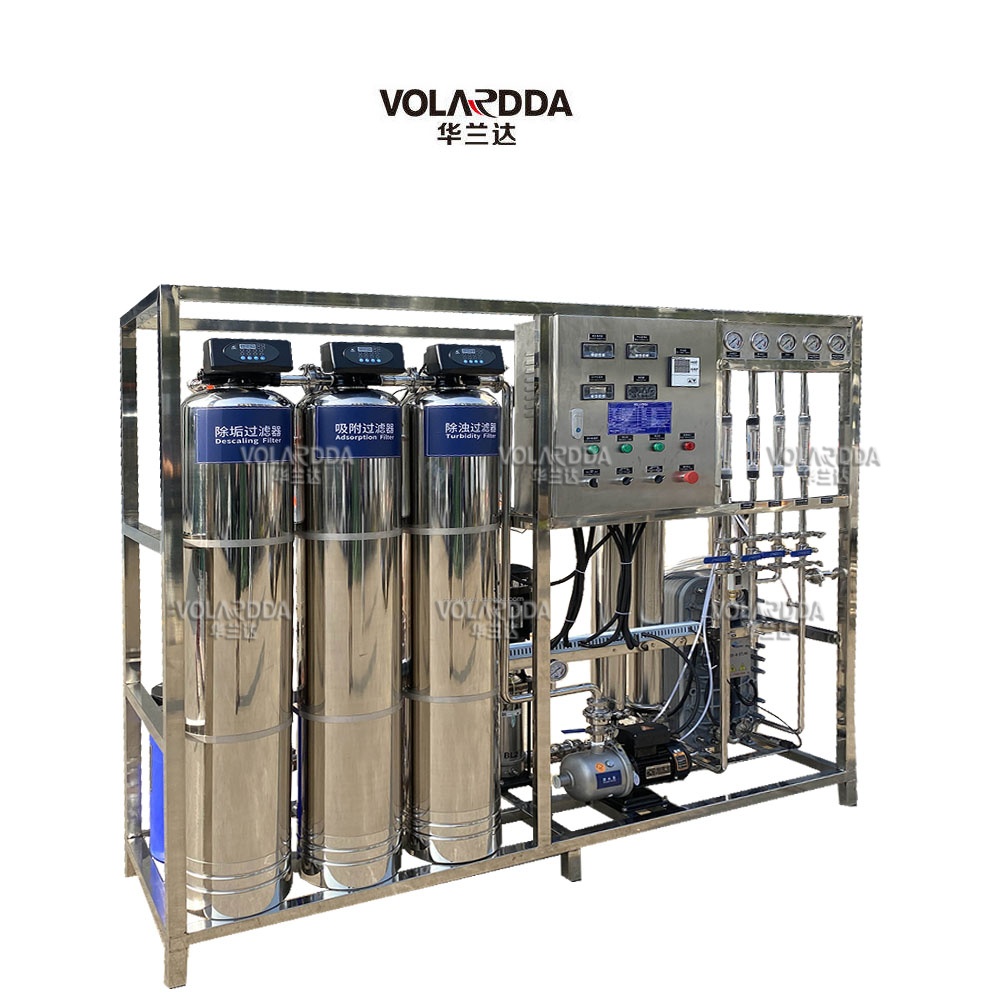

Standard scope of supply for this configuration.
| Technical specifications | |
|---|---|
| Equipment model | HLDRO—EDI—500L |
| Water production | 500 L/H |
| Influential water source | TDS ≤250 PPM, water temperature 25 ℃ |
| Produced water quality | Conductivity <10 μs/cm, total organic carbon <0.5 mg/L, microorganism <100 cfu/ml |
| Desalination rate | 96-99% |
| Water recovery rate | 50-70% |
| Power supply | AC220V/50Hz or AC380V/50Hz |
| Power | 1.5-2.2 KW |
| Work pressure | Pretreatment 0.2-0.4 MPa, RO host 0.8-1.5 MPa |
| Inlet diameter (mm) | DN25 |
| Outlet diameter (mm) | DN20 |
| Equipment size (mm) | 1800*580*1630 |
| Equipment volume area | about 1.5 m² |
| Packing volume | about 2.35 m³ |
| Weight (KGS) | 230-300 KGS |
| Applications | Purified drinking water, purified water used in beverage and food factories; production water in daily chemical products factories, biopharmaceutical water, medical equipment cleaning water, reagent preparation water, hospital dialysis water, oral liquid water, medical purified water, electronic semiconductor production water |
Specifications are typical for the standard configuration and are confirmed on the approved drawing before production. Capacity, voltage and footprint can be adapted to your site.
Tell us the raw water source, the hourly flow you need and the target water quality. We will confirm capacity, recovery and power before you commit.
Sand, carbon and softener vessels condition the feed water so the RO and EDI stacks see a stable, low-fouling stream.
A two-stage RO array removes the bulk of dissolved solids and brings conductivity down to the single-digit us/cm range.
Treated water is buffered in a stainless tank, which decouples RO output from the EDI demand.
An electrical field drives ions through ion-exchange membranes, so no acid or caustic regeneration is needed.
Polishing and 0.22 micron filtration deliver water at 10-18.2 MOhm.cm to the point of use.
Inline resistivity, flow and pressure transmitters report to the PLC and log every batch.
Yes. EDI needs a low-conductivity feed, so RO is always part of the train. The EDI stack then polishes the permeate to ultrapure quality without chemical regeneration.
EDI runs continuously and regenerates electrically in place, so there is no acid or caustic handling, no resin replacement shut-down and no chemical waste stream.
Resistivity of 10-18.2 MOhm.cm depending on the feed and the polishing loop, with TOC below 0.5 mg/L and microbial counts under 100 cfu/ml.
Annual inspection of the stacks, seals and electrodes, plus continuous monitoring of differential pressure and resistivity. Consumables are limited to cartridge filters and UV lamps.
The PLC handles start-up, standby, alarm and data logging, so the plant can run with a daily operator round rather than full-time attendance.

Built-in ultra-pure water circulation program to ensure the purity of the water quality, install precision disinfection …

EDI high-purity water manufacturing technology is mainly used in optical instruments, dialysis, biopharmaceuticals, semi…
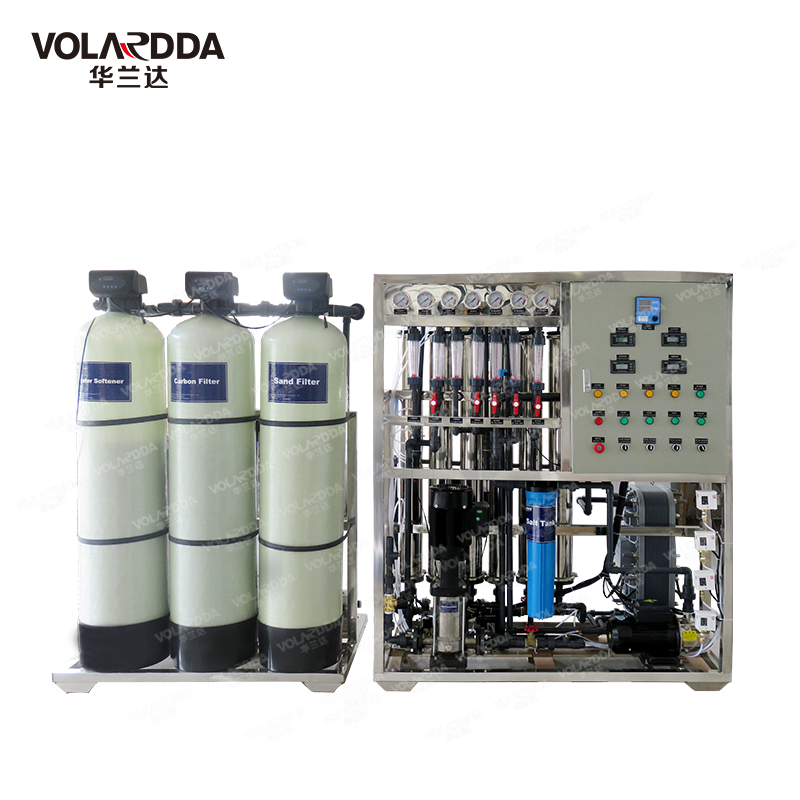
EDI high-purity water manufacturing technology is mainly used in optical instruments, dialysis, biopharmaceuticals, semi…